The definition of conflict can have many meanings, although in simple terms, we can define conflict as something that occurs when two or more people want the same or different things but only one person is able to get what they want.

Most conflicts usually stem from a disagreement that has not come to a successful conclusion, and can result in an argument, verbal abuse or acts of physical violence. For example, a group of fathers head to their local store to pick up a toy for their sons for Christmas, but when they get there, they find that there is only one toy left to buy.
As they all want the same thing, a disagreement is likely to occur which could then result in a conflict over who should get the toy and who will have to go home and disappoint their son.
Types of Disagreements
Most people would say that they experience conflict in one form or another at least once a day. This might be true, but often, many “conflicts” are actually mistaken for disagreements.
Therefore, if you can learn to distinguish true conflicts from simple disagreements, you will automatically remove a lot of false conflicts from your life. This is because it’s far easier to stop a conflict before it begins than trying to stop one once it has already been set in motion.
The three main types of disagreements that people can have are listed below:
1) Having Different Opinions Regarding a Fact
A very common cause of disagreements occurs due to people having different opinions about a particular fact. There is one correct answer, but both people feel that they know what the answer is and that the other person is wrong.

For example, you say that the capital of England is Manchester, but I say that it’s London.
Although I am right, it really doesn’t make any difference whether or not we agree. As long as we don’t have to teach it, or take any action on it, then it simply doesn’t matter that you and I have a different opinion on this fact.
Such disagreements will often lead to good-natured disputes or debates, whereby one person calls into question the truth or validity of what the other is saying. In most cases, this won’t progress any further, and both parties will walk away with each person thinking that they are right.
The simplest way to resolve a dispute regarding a fact is to provide evidence which proves that fact. Alternatively, a neutral third-party could be introduced to provide their opinion on the matter or to provide proof.
2) Having Different Interpretations of Reality
Another common cause of disagreements occurs due to the way that people interpret their reality, and this is largely affected by the type of personality that someone has and their general outlook on life.

For example, two work colleagues experience a setback on a project which they have been working on. One person says “this is awful, it’s terrible, we might as well just give up now” whilst the other person says “this has been a valuable learning experience, at least we won’t make that mistake again“.
Whenever you are dealing with different interpretations of reality it’s usually best to agree not to disagree, because very rarely will you be able to change the way that a person looks at a particular situation without having an in-depth conversation with them.
This, however, poses the risk of creating tension which may then lead to quarreling and conflict. So it’s better to allow a person to keep their opinion, and you keep yours, and then get back to whatever it is you both have to do.
3) Blaming Another Person For a Past Wrong
Out of all the three disagreements, blaming another person for past wrong doings has the greatest potential for turning into a heated argument that is fueled by feelings of resentment and bitterness and which may then erupt into violence.
Common phrases that signal such a confrontation is about to begin include “why did you do that?“, “you should have done that differently“, “it was because of you that…“, “it’s your fault that…” and “look at what you did“.
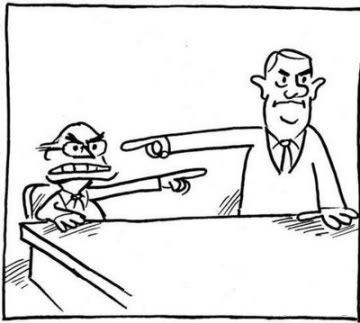
The best way to stop this type of disagreement turning into a conflict is to avoid confronting another person in such a manner, as doing so will only cause a person to become defensive and respond to you in an emotional rather than logical way.
This doesn’t, however, mean that you can’t point out the wrong that someone has done so that it can be talked about and improved for the future. Rather, it means that you should be cautious about the way you approach such an issue which is already very sensitive in nature.
If you are the person who is being blamed for a past wrong, then you have two choices: argue against what has been said, or accept it and apologize for your actions.
Acceptance and apology is always the best option if you were genuinely in the wrong, as this will help to diffuse any anger that your accuser is experiencing and thus minimize the risk of a full-blown conflict from occurring.
4 Ways to Neutralize Disagreements
As you will never get on with everyone you meet, you are bound to disagree with people from time to time.
But this doesn’t mean that all your disagreements are going to result in conflicts, because disagreements are just a bunch of words. It’s how you act on those words which determine how likely you are to progress into a full-blown conflict situation.

If you find yourself disagreeing with someone as a result of you having a difference of opinion, different interpretations of reality, or as a result of something which someone may have done, try to use one of the following four solutions to end your disagreement and prevent it from escalating into a conflict:
1) Have a Friendly Discussion
Providing that you are dealing with a mature and responsible adult, you should be able discuss the issue in a calm and relaxed manner.
Try to avoid making accusations during your discussion, as this will cause a person to largely ignore what you are saying even if they know that you are right.

Stick with the facts, and try to be as neutral and understanding as possible without putting the other person down.
If you can accomplish such a discussion, you and the person who you have disagreed with, are likely to feel much better about the situation and you won’t have to worry about them harboring feelings of resentment towards you or holding a grudge against you.
2) Ignore the Disagreement
Some people are incapable of having a calm and mature discussion. They get wound up too easily and become overly emotional when someone doesn’t completely agree with their way of thinking.

There are also people who will try to push your “hot buttons” by deliberating making provocative statements which they hope will wind you up and get you drawn into a debate or argument.
In such cases, it’s usually best to ignore the disagreement altogether and walk away. If you don’t, you will probably get drawn into a heated argument and a full-blown conflict with shouting, insults and maybe even violence.
So with some people, it’s important to recognize that you can’t win. Just be content to give them their hollow victory, and devote your time towards something more constructive and meaningful.
3) Agree to Disagree

The best time to agree to disagree is when another person is convinced that they are right and that you are wrong. This is because unless you are able to present evidence which can prove who is right, both of you are likely to stick with your own point of view.
In such cases, agreeing to disagree can be a simple and effective solution, because you both get to keep your own opinion and nobody loses face by being wrong.
4) Practice Forgiveness
Some medical professionals believe that many long-term diseases are caused by people harboring feelings of resentment about events that occurred long ago.
It is well-known that negative emotions such as anger and fear, for example, can weaken a person’s immune system. So rather than keeping these feelings inside of you where they could be doing you harm, try to forgive a person for their mistakes or for what they have done.
Very often the act of forgiveness will take a great weight off your mind, and will make you feel much more at ease and better able to focus on your future goals and activities.

If you don’t want to forgive someone, but also don’t want to have a conflict with them, then try to avoid talking about the mistakes they have made if you feel that bringing up the issue is going to cause more harm than good.
You should, however, always bring to attention past mistakes a person has made when those mistakes have serious real world consequences, such as a loss of productivity or revenue in the workplace.
Although, if you choose to bring up such mistakes be sure to bring them up immediately, as dredging up lots of different mistakes from long ago is going to make it seem like you are scrutinizing and victimizing a person.
Why Do Conflicts Occur?
Conflict stems from a difference of interests or a belief that two people’s wants and needs cannot be achieved simultaneously.
In other words, conflict is based upon a belief that “if you get what you want” then “I can’t get what I want“. Conflict then occurs in an attempt for each person to get what they want.
The two main reasons why people tend to have conflicts are:
1) Different Interests
This is the most common reason why conflicts occur, because having different interests to another person will increase your chance of having a confrontation with them.
The greater the difference between these two interests, the greater the potential that a conflict will breakout.

For example, a teenager wants to go to the cinema with his friends, but his mother wants him to stay in and help her with chores around the house. These two very different interests are likely to result in the teenager and the mother getting very upset and annoyed with each other.
If the difference between these two interests were minimized, such as by the teenager agreeing to do the chores tomorrow if he is allowed to go out tonight, the risk of these different interests resulting in a conflict will be significantly reduced.
2) Conflicting Interests for the Same Thing
Conflicting interests occur when two or more people are pursuing a limited resource but differ in how they try to obtain it.
For example, we both want a promotion but there is only one promotion available. Another example could involve someone who is selling a house, but the buyer is only willing to pay a price below that which has been asked for.
In both cases, the interests held are the same, but the details of those interests differ which subsequently causes a disagreement that may then lead to a conflict.

The likelihood of such a disagreement turning into a conflict will largely be dependent on how flexible you are in getting what you want.
If you are completely inflexible, such as you believing that you should get a promotion and that I shouldn’t, then the chance of us entering into a conflict will be relatively high.
If, however, you are willing to exhibit some degree of flexibility, such as by being willing to negotiate on the selling price of your home, then the risk of us entering into a conflict will be low.
Resolving Conflicts
Most people approach a conflict by first stating what they want to happen. This automatically tells the other person the decision you have made and your solution to the conflict. Of course, if the other person agrees with you and is willing to do what you say, then this isn’t a problem.
But more often than not, you will find that people won’t agree with you immediately, and so if you have stated your solution right at the very start, you will be much more likely to enter into a conflict as a result of that disagreement.
This occurs because most people tend to stick with what they first propose, as changing their mind can make it appear as though they are giving in or admitting defeat.
Therefore, to save face, it’s far more likely for a person to stand their ground and hold onto their original position.

A better way to approach a situation is to talk about interests. These are the things you hope to do or achieve, rather than the things you believe should or shouldn’t happen.
Talking about your interests has two major advantages. First, because you are not telling a person what you want them to do, they will be less defensive and resistant to what you’re saying as your words won’t be seen as a personal attack or threat towards them.
The second thing you achieve is that because they are now less likely to raise their guard up against you, it makes reasoning with them a lot easier.
This occurs because whenever a person feels threatened or under attack they predominantly respond with their “reptilian brain”, which is a part of the brain that deals with primitive urges and behaviors such as aggression.

A person who is not feeling threatened will respond in either an emotional or rational way based on the emotional context and facts of what you are saying. As a result, if they are able to sympathize with you, or see that your point of view makes logical sense, they will be much more likely to agree with your proposal.
You must, however, be willing to be flexible in how your interests are fulfilled, as even though a person may sympathize or understand your point of view, they still may not be willing to do exactly as you have asked because they will also be driven by their own wants and needs.
Unsurprisingly, these wants and needs will often act as a stronger motivator than your wants and needs.
Discussing Interests Can Prevent Conflicts Occurring
Here is a quick story that will help you remember the importance of discussing interests:
There are two sisters and they both want one apple. There are no other apples available, and they don’t want anything else except the apple. Both sisters want the same thing, and so appear to be in conflict with each other. What do they do? How can they solve the problem?
The first and most obvious answer would be to split the apple, thereby giving each sister half an apple. But this will mean that they only get half of what they want, which is not a satisfactory solution. So how else could the problem be solved?

We could start by asking the sisters why they want the apple (their interests). One of the sisters says that she wants to eat the apple. The other says that she doesn’t want to eat it, as all she needs is the peel so that she can add flavor to a cake which she plans on baking.
This simple story shows that by focusing on interests first, you may sometimes discover that what a person actually wants is different from what they originally said they wanted.
In such a case, you are likely to find it much easier to discover a solution that will satisfy both people completely, and when that happens, you have just achieved a win-win situation as everyone ends up getting what they wanted.
Avoiding Conflicts Requires Cooperation
Considering interests first will not always be successful in avoiding or resolving conflicts, as there will be instances when a win-win situation cannot be achieved.
You will, however, vastly increase your chances of preventing a conflict by talking about your interests, and the interests of the other person, before you each state what exactly it is you want to happen.

What this all means is that conflicts are best avoided and solved by cooperation. You simply can’t force a person to agree with you, and if you try, you are likely to resort to abuse, blackmail or violence and will then have to suffer the consequences of your actions.
So it’s important to remember that conflicts can only be truly resolved if the other person is willing to work with you to resolve it. If they are not, then your conflict with them will remain unresolved.
Videos





Reviewed – 23rd March 2016