Being a creative person means being able to think up new ideas or new ways things can be done. Traditionally, creative people are often associated with business, as creativity is necessary for the process of invention and innovation.
This allows people to come up with better, faster and cheaper ways of doing something, which then results in others wanting to use the good or service that they have produced. A good example of this can be found with Amazon.com.

Amazon decided to stock their books in a giant warehouse and sell them over the Internet. Because they were no longer limited by space or location, they could offer a greater selection of books, at a lower cost, and to many more people than traditional bookstores could.
This one simple idea gave Amazon the advantage they needed to become a success in what was already a very competitive market. They are now the leaders in their field. That’s what creativity can do for you, and why it’s so important to be a creative person!
21 Easy Ways To Be More Creative
Being a more creative person will benefit virtually every area of your life. If you can be creative in business like Amazon.com, for example, it can help to make you money.
If you are creative in relationships, it can help to make you a more socially interesting person. And if you can be more creative in how you pursue your goals, it can help you to become a happier and more successful person. So being creative is not without its benefits!
If you want to benefit from bringing creativity into your life, use the following 21 tips listed below:
1) Use Divergent Thinking

As people are naturally drawn towards the strange and unusual, you can quickly captivate a person’s attention by showing them something unexpected such as the picture above of a garden inside a car. The easiest way to do this is to combine unrelated things which don’t normally go together.
2) Don’t Conform

In order to avoid standing out from the crowd and possibly looking foolish in front of others, most people tend to do whatever is considered socially acceptable. They play it safe, and don’t take too many risks.
Whilst this may be a good strategy for avoiding potential embarrassment, it’s definitely not a good strategy for being creative! Creativity comes from doing things differently, so if you always conform, it’s unlikely you will ever be very creative. So go ahead, express yourself!
3) Don’t Let Others Discourage You

Children can learn from an early age to suppress their innate curiosity as a result of wanting to please and gain the approval of their parents.
Later in life this can continue as a “people pleasing” syndrome, whereby the grown adult puts their own interests aside in order to “make” others like them by going along with the status quo.
Don’t let what other people want or expect influence you in a negative way. If you want to do something, then do it. Once you can adopt this attitude in your life, you will regain the curious mind you had as a child which will then make thinking up great ideas a whole lot easier!
4) Don’t Limit Your Brain
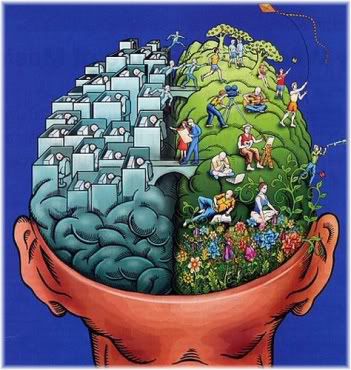
There is a pervasive myth going around that humans only use 10% of their brain. Movies such as “Limitless” and “Lucy” promote the idea that if we could only use the remaining 90% of the brain, then we would all be a lot smarter.
This isn’t true! Humans use 100% of the brain. We just don’t use it all at once. So don’t limit your creativity by thinking that your brain is somehow limited. Coz it isn’t!
5) Be Aware Of Negative Emotions
When you are angry, upset, stressed or consumed with any kind of negative emotion, areas of the brain that are responsible for creative and rational thought are shut down.

This then causes you to respond to stimuli using the irrational emotional part of your brain, the limbic system.
The results of this type of thinking often lead to poor decision-making, ignoring facts contrary to your current beliefs and an inability to think or concentrate clearly.
So if you find yourself in a bad mood, take a break and do something else as you are unlikely to be very productive in such a frame of mind.
6) Relax
Creativity is most easily accessed when you are in a relaxed state of mind and are feeling calm, happy and comfortable.
This means that the more positive you can become when working, the greater will be the quality and quantity of your ideas.

The importance of relaxation for creative thinking is well-known in the business world. Companies such as Facebook, Google and Yahoo, for example, try to create an environment that their employees can have fun in as well as work.
The same can be found with ad agencies which rely on creative thinking to keep their business alive, as they often have relaxation rooms in which their staff can sit or lie down when trying to come up with new ideas for a marketing campaign.

You can apply the same principles of relaxation to your own work by ensuring that your working environment is as pleasant as possible.
If you find yourself becoming stressed out, take a break and do something that you enjoy, as you will often find that your best ideas come when you least expect it.
7) Don’t Worry
Worry is a big blocker of creativity, as once you start to worry that you won’t be able to do something, you will find it difficult to relax and will soon be consumed with negative emotions.
For this reason, it is important to recognize when you start worrying so that you can then take action to stop that worry from spiralling out of control.

One of the best ways to deal with worry is to stop what you are doing and say to yourself “these negative thoughts are not helping me”. After you have said this, go and do something completely different, trusting yourself that the answer will come when the time is right.
Remember, creativity is something that can’t be forced. So the more you surrender to the process just described, the more likely you will be to come up with a creative idea.
8) Take A Break
The brain needs time to process the information it receives before it can come to a conclusion or find a solution to a problem. Sometimes, a short break to visit the restroom may be all that’s needed for this to occur. At other times, you might need to sleep on it.

Breaks are most effective when you feel that you have hit a brick wall and can go no further, as this usually signals that the brain needs more time to think things through.
If you allow yourself this time, you should find it easier to break through such barriers and will often see things from a completely new point of view and level of understanding.
9) Be Confident

When trying to solve a problem, approach it with an attitude of confident expectation. This means believing that it’s just a matter of time before you eventually find the answer that you are searching for.
This mentality will also help you to avoid becoming discouraged when facing a large challenging problem, as you will know that if you stick with it long enough you will eventually overcome it.
10) Avoid Functional Fixedness
Functional fixedness is a belief that something can only be done in a particular way, and, to borrow an old cliché, it’s one of the biggest barriers to “out of the box” thinking that you are likely to come across.
An example that helps to demonstrate what is meant by functional fixedness can be found with the invention of the airplane.
When people were first trying to fly, it was believed that flapping wings were necessary because that is how birds are able to fly. As a result, most of the first attempts to fly were based on some kind of flapping wing design.

The Wright brothers, however, realized that as long as you get the aerodynamics right then you could in fact create a fixed wing aircraft. After their first successful flight, they were able to break the established belief that you needed to flap like a bird to fly.

You can avoid functional fixedness by trying to think of odd or unusual ways to do something, something that seems so bizarre that most people would regard it as a “crazy idea”.
Most of the ideas that you come up with will be “crazy” and can be quickly discarded. But if you come up with enough ideas, you will eventually find one or two gems that provide you with just the answer you were looking for!
11) Daydream

When you daydream, you let go of the way that things should be, the way they are, and enter a world of infinite possibilities where anything can happen.
This state of mind is particularly conducive to creative thinking, as it enables you to think about things in a different way to how you normally would.
Since creativity involves coming up with new and better ways of doing things, just like how Amazon.com did, as we discussed earlier, once you start to think differently you will automatically start to think more creatively as a result.
12) Talk To People

Talking to another person about something you have on your mind is a great way to explore that issue in greater depth and get someone else’s perspective on it.
This in turn can stimulate new ideas which you may not have thought of before, and encourage you to consider a greater range of alternatives than you previously had done.
13) Don’t Jump To Conclusions

Be open to different ways of exploring a problem, and avoid the temptation to automatically jump to conclusions and assume that you know the answer. Consider as many different possibilities as you can, as the best ideas usually come after considering many.
14) Concentrate On One Thing
Your brain can only hold one thought at a time, so try to focus your complete attention on the task at hand. The more you allow yourself to become distracted by something (e.g., what’s on TV later?) the less brain power you will have available for solving your primary task.

If you find yourself being easily distracted, then you may not be in a working environment that is conducive to creative thinking.
Some people, for example, work best in a quiet environment. Whilst others, work best when they have some kind of background noise.
Determine the environment in which you are best able to work, and then do all or the majority of your work in that environment with as few distractions as possible.
15) Exercise
Exercise helps to increase blood circulation around the body and provide oxygen to your cells.

Since the brain uses about 15-20% of the body’s blood supply, doing some form of exercise each day is vital for keeping your brain healthy and ensuring that you are able to think clearly and concentrate properly.
Even if you don’t like to exercise, try going for a walk instead of going to the gym. Your brain will thank you for it, and you may even get a few good ideas along the way!
16) Have Goals

Having clearly defined and written goals can give your creative mind a major boost. This is because if you write down your goals, and then look at them every day, your subconscious mind will start to work on ways that those goals can be achieved.
The best part about this process, is that it occurs largely automatically. As a result, you may one day suddenly find yourself presented with the solution to your problem, thereby allowing you to take immediate and effective action on it.
17) Let Your Dreams Guide You

Ancient cultures used to use dreams as a means of alerting them to dangers in their future, and for solving problems they were struggling to find an answer to.
You can use dreams to help you become a more creative person by having a clear intention in mind before you fall asleep. You will often find that when you wake up in the morning, or the following morning, that your answer has come to you in a dream.
To make the most of the ideas that come to you in your dreams, keep a pen and pad of paper next to your bed so that you can record your dreams immediately upon waking.
18) Use Positive Language

Avoid using negative limiting language such as “this is impossible” or “I could never do that”, as such language creates barriers in the mind that can limit your thoughts and actions.
If you always talk to yourself in this way, for example, you are unlikely to bother even attempting to solve a problem, and if you do try, you probably won’t put very much effort into it and so will soon give up.
19) Define The Situation

Make sure that you clearly understand what you are trying to achieve and what resources you have available to work with. As if you go into something with only a vague idea, you will most likely end up feeling frustrated, unhappy and produce poor quality work.
You should therefore aim to educate yourself as much as you can about the task at hand before you start it, as this will give you a lot more information and ideas to work with.
20) Ask Questions
In order to get an answer, you first need to ask a question, and the more questions you ask, the more answers you will get.

If you find yourself stuck with something, try asking yourself a series of questions relating to your problem and then consider the opposite of the answer you get.
Asking questions will encourage you to approach things from multiple perspectives, consider new possibilities, and ultimately, make it much easier to find the solution to your problem.
21) Write 20 Answers
If you have a task that you are trying to solve but can’t seem to think up any good ideas, try writing down a list of twenty answers to the challenge you face.

The first few answers are likely to come easily, as these will come from your conscious mind. The last few answers will be the most difficult, but they will usually be the most valuable as they will come from your subconscious mind.
However, in order for this method to work you must do the list in one attempt. So make sure that you have plenty of free time to do it in!
You can enhance the effectiveness of this technique by doing the exercise before bed. You might then find that you get an answer in your dreams, or when you wake up in the morning.
Videos




Reviewed – 23rd March 2016